 Janine Bergmann
Open Water Diver: my dive certification in the Red Sea
How I earned my Open Water Diver in Makadi Bay: from the first nervous minute underwater and a sleeping giant turtle to a passed certification after almost an hour in the Red Sea.
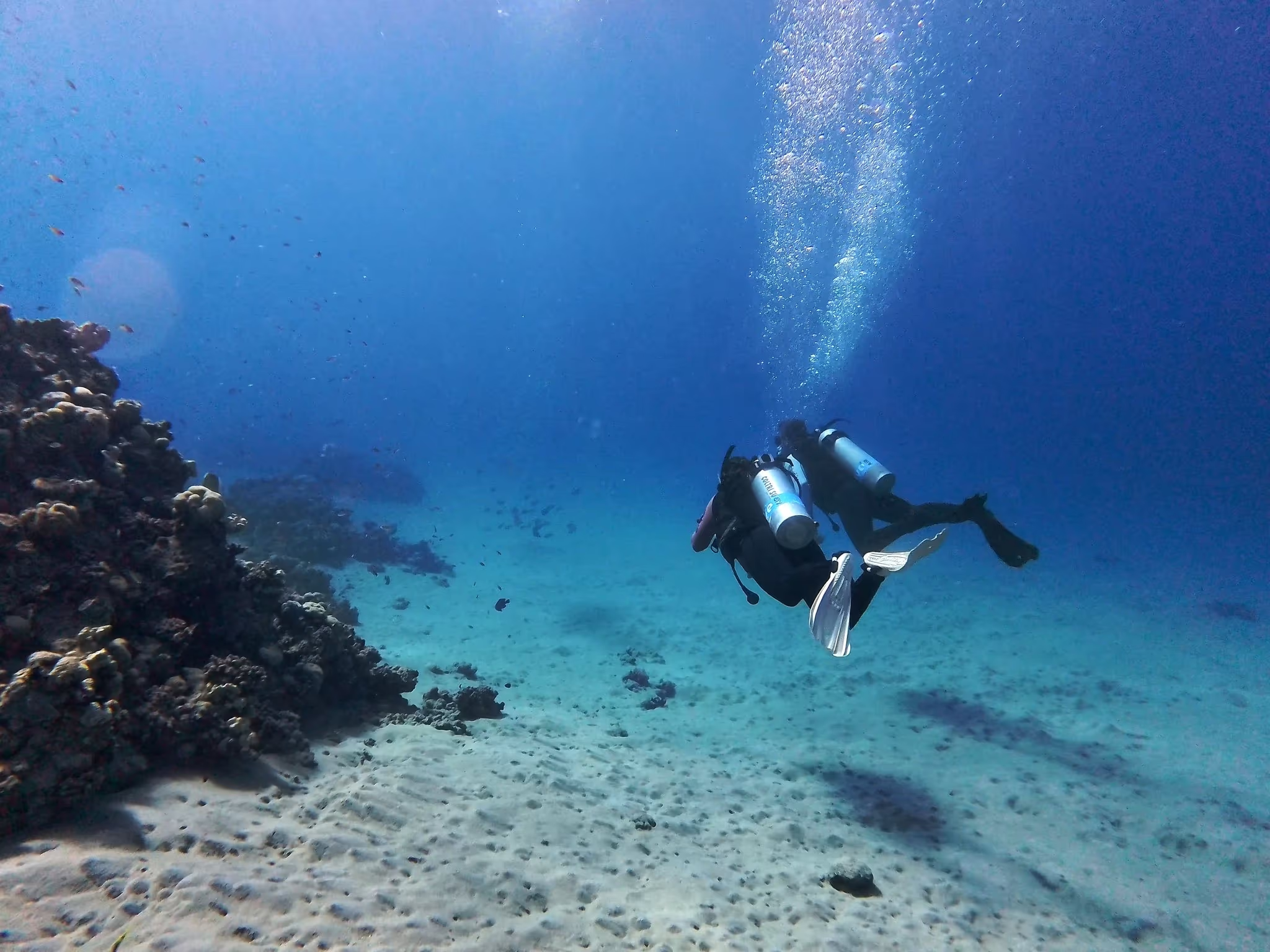
Contents+
A sleeping turtle
Hassan makes the hand signal for a turtle and then lets us know that it's currently asleep. And there it is: a huge turtle, roughly as long as I am, resting among some corals and sleeping. Even though I don't have a camera with me, this image burns itself into my brain. And for that alone the course was already worth it.
Why get certified in Egypt
Back on our last trip to Florida, Philipp, who already has a dive certification, was sad that all we could do on the Keys was snorkel. So for me it's clear: I urgently need to catch up. I would have loved to get certified right away, but in Germany it's simply twice as expensive and, because of the low temperatures, only possible from March to October. What would cost me almost 800 euros here costs me 320 euros in Egypt, and on the training dives I get to see far more than in Germany. Not that Germany doesn't have beautiful spots to offer, but most Open Water courses are done in a pool first and only the open-water dives take place in a lake. Why do that when you also have the option to dive in the Red Sea?
Theory from the couch
After booking a resort in Egypt in January, one that's completely different from our usual holidays, I got straight in touch with the dive school at our resort. With PADI you can study the theory at home in advance, so you don't waste your holiday on tedious studying. So I'm looking forward to finally learning something new again and throw myself into the various lessons with great enthusiasm. In winter you end up sitting around at home far too much anyway, and I use that time to work through a theory session again and again. Highly motivated, I jot down everything I think is important. After all, your knowledge is tested not only at the end of each lesson but there's also a final exam at the end. But don't worry, I seem to remember that you can keep answering the questions until you pass, so there's basically no chance of failing, exactly the kind of exam I like.
The first, less than relaxed dive
Finally, in May, the practical part can start too: the IDive Makadi Bay is right next to our hotel. Good thing I'd already booked and paid a deposit for the dive course, because my first time below the surface wasn't exactly relaxing. My instructor Hassan is still busy with someone who's just finishing their Open Water Diver, and my job is simply to wait underwater, not so easy after all. Breathing evenly from an air tank is hard for me, and so is regulating my buoyancy. Honestly, I'm just busy trying not to die. What on earth was that, I ask myself.
First depth: 12 metres
Nervous, I wait for Philipp by the pool, honestly not particularly keen to start my next dive. This time Hassan only has time for me and the second dive starts much more relaxed: with 7 kg of weight around my belly, we go down to 12 m for the first time. Beforehand, out of the water, all the hand signals were explained to me, as well as my tasks and exactly how I'm supposed to handle them: clearing cramps, ditching weights in an emergency, switching between snorkel and regulator. I'm immediately reassured to have it explained to me what to do in emergency scenarios.
The mask exercise
On the second dive already I reach the 18 m that are the goal of the Open Water Diver, and I learn to take off my mask underwater and put it back on fully flooded. I'll admit, swimming that stretch without a mask was definitely not my favourite task, but it was very helpful for learning how to clear a flooded mask underwater. At the time I had no idea how often I'd still need that. When you keep borrowing equipment, you unfortunately have to expect that it won't always fit.
Between wind, navy and the house reef
Hassan makes an effort to ensure the dive isn't just about tasks, but that you also get to know the wonderful underwater world. We have a house reef where you can start a beautiful tour. Lucky for us, because we hit a week of very windy weather, and here it's the navy that decides whether boats are allowed out or not. As it turns out, no boats are allowed to set off for the rest of the week, so the pleasure of a boat dive is denied to me. But thankfully you can dive the house reef not only going left but also going right. In between we keep taking a rest day or do just one dive, hoping the navy will clear the boat trips again soon.
Octopuses, moray eels and freezing feet
I'm fascinated by the underwater world, and I find Hassan's passion for it and his sharp eyes even more impressive: from the greatest distance he spots a well-camouflaged octopus that I'd never have noticed, even if I'd swum right over it. Moray eels and lionfish are a more common sight here, and the little bluespotted rays that hide so well on the sandy bottom I can now spot fairly well myself. The water is 24 degrees, but I freeze like crazy and by the end can barely suppress the shivering. Every time I come out of the water completely frozen through. Luckily Hassan takes pity on me and for the last dives I get a pair of neoprene socks, a real game changer. Apparently you lose an incredible amount of heat through your feet. Rather nice side effect: the fins stop chafing so badly, too.
The last dive with Philipp
After I've also learned how to inflate a surface marker buoy and use a compass (which, admittedly, I'd already forgotten again by the time of my AOWD), Philipp gets to join me on my last dive. It's just the two of us, fantastic. Hassan has such a calm, easy manner, and thanks to the eye he has for the underwater world it feels like doing a completely different tour, even though you've already seen the reef a few times. Diving with a dive buddy you know is also much more relaxing as a beginner.
My highlight, besides the huge turtle I described at the start and the octopuses hiding in the corals, is a tiny little dragon fish, only a few centimetres long. In German it's probably a "Flügelrossfisch," with shimmering wing-like fins like a dragon.
After almost an hour underwater I surface, overjoyed and with a passed certification.
Passed, and the first fun dive
We celebrate it the last and, at the same time, next day with my first fun dive, a dive on which I'm officially no longer a student. Since I didn't have my own underwater camera at that point, I sadly couldn't capture any of my first dives. All the nicer that on our last dive someone came along with a camera. So a few weeks after our holiday, at least I get sent a few pictures of these wonderful experiences.
The decision is made: I need my own action cam.
Gallery
Q & A
What does the Open Water Diver cost in Egypt compared to Germany?+
In Germany I would have paid almost 800 euros; in Egypt it was 320 euros, and on the training dives you get to see far more in the Red Sea.
Read the full story: Why get certified in EgyptCan you study the theory before the trip?+
Yes. With PADI you can study the theory at home in advance, so you don't waste your holiday on tedious studying. Your knowledge is tested at the end of each lesson and there's a final exam, but you can keep answering the questions until you pass.
Read the full story: Theory from the couchHow deep do you dive on the Open Water Diver?+
The goal of the Open Water Diver is 18 m of depth. I reached it on my second dive already.
Read the full story: First depth: 12 metresHow cold was the water, and what helped against the chill?+
The water was 24 degrees, yet I came out completely frozen every single time. A real game changer was a pair of neoprene socks. Apparently you lose an incredible amount of heat through your feet. Nice side effect: the fins stop chafing so badly, too.
Read the full story: Octopuses, moray eels and freezing feetDo you need to be a strong swimmer for the diving licence?+
Yes, in my opinion you should feel absolutely comfortable in the water and above all be aware of where your own physical limits are. Do not overestimate yourself.
How many days does the Open Water Diver take?+
In most cases it is adapted to your needs. The certification is easily done in 4 days, but always plan in a little buffer.
What do you do if panic sets in underwater?+
Stay calm, keep breathing steadily and get out of the panic situation as quickly as possible. If you have a problem with panic attacks, this is not the right thing for you.
Read the full story: The first, less than relaxed diveDo you need your own equipment?+
No, especially not at the beginning, you can rent everything. Rental gear is of course not always as good as your own, but for a start it is perfectly fine. Equipment is hard to transport on flights and not exactly cheap either.
Is Makadi Bay good for beginners?+
Yes, definitely: no current and, in my case, even a house reef, so perfect conditions.
Read the full story: Between wind, navy and the house reefKeep reading
Diving in Bali: Between Manta Rays, Sharks, and Turtles
From the cliffs of Uluwatu to the rice terraces and temples of Ubud, from the manta rays off Nusa Penida to the dives on Gili Trawangan: my travel diary from two weeks in Indonesia.
Advanced Open Water Diver on Gili T: from fun dive to the next certification
We actually just wanted a few relaxed fun dives on Gili Trawangan, and ended up with my Advanced Open Water Diver. From deep diving and navigation to sleeping reef sharks and bioluminescence on the night dive.
Sri Lanka Road Trip: Two Weeks Between Jungle, Tea Plantations and Dream Beaches
From a jungle night in Sigiriya to the Temple of the Tooth in Kandy and the legendary train ride to Ella, all the way to surfing in Hiriketiya and baby turtles in Mirissa: our travel diary from two weeks in Sri Lanka, with waterfalls, a cooking class, a safari letdown, and way too loud cities.